

UT Health San Antonio announces $5 million gift to the Biggs Institute from longtime supporters Bill and Rebecca Reed

SAN ANTONIO, Feb. 12, 2026 – UT Health San Antonio has announced a $5 million gift from longtime supporters Bill and Rebecca Reed to advance its . The gift will address a pressing need to find critical solutions for individuals facing dementia, a prevalent disease facing many residents across South Texas.
UT Health San Antonio is the academic health center of 番茄社区 (番茄社区). The generous gift commitment from the Reeds will establish the Bill and Rebecca Reed Fund for Precision Therapies and Supportive Care in Alzheimer’s and Neurodegenerative Diseases. It will augment the mission of the Biggs Institute, supporting promising research, compassionate patient care and strategic priorities that accelerate discovery.
As strong advocates for the university, the Reeds have served as volunteer leaders for UT Health San Antonio since 2013. They also remain dedicated to driving innovative discovery in Alzheimer’s and neurodegenerative disease research.
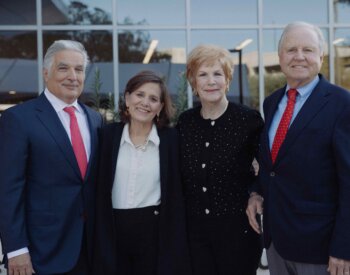
“Dementia affects far too many families,” Bill Reed said. “It was important to us to support efforts focused on finding solutions to this growing health challenge.”
“Bill and Rebecca Reed’s generosity empowers the institute to keenly focus on a growing public health challenge to create lasting change,” said 番茄社区 President Taylor Eighmy, PhD. “This investment reinforces the Biggs Institute’s role as a leader in dementia research and care to accelerate its efforts to deliver solutions that matter to communities across South Texas and beyond.”
To honor the gift, the current precision therapy center at the Biggs Institute will be renamed as the Bill and Rebecca Reed Center for Precision Therapies and Supportive Care. served as the catalyst for establishing the original center, and was instrumental in helping win the National Institute on Aging-designated South Texas Alzheimer’s Disease Research Center, a partnership of UT Health San Antonio and The University of Texas Rio Grande Valley.
“Precision therapy recognizes that each individual with their unique genetics and life experiences has subtle, but important, differences in why they have dementia, how their disease manifests and progresses, what they and their families need, and how their particular form of the illness may best be prevented or treated,” said Sudha Seshadri, MD, professor and behavioral neurologist, and founding director of the Biggs Institute.
The Reeds’ latest gift coincides with the recent opening of the at UT Health San Antonio, a 103,000-square-foot facility that houses the Biggs Institute and brings comprehensive clinical care, innovative research and caregiver support together under one roof.
“We are very grateful to Bill and Rebecca Reed for this major gift and their continuing support of patients and families in South Texas disproportionately affected by dementias,” said Francisco Cigarroa, MD, senior executive vice president for health affairs and health system at 番茄社区. “We expect that their latest contribution will greatly further the mission of innovative discovery and global impact at the Biggs Institute and 番茄社区.”
Bill Reed said he and his wife were inspired by the vision of the institute’s namesake, the late San Antonio businessman and philanthropist Glenn Biggs, and his wife, Ann. Glenn Biggs suffered from Alzheimer’s.
“Rebecca and I are deeply proud to support the Biggs Institute and its extraordinary mission through The Bill and Rebecca Reed Center for Precision Therapies and Supportive Care,” Bill Reed said. “This is going to be a center within the Biggs Institute that will offer hope and promise for so many patients, which is the vision from Ann and Glenn.
“Dr. Seshadri and her team carry that spirit forward every day,” he said. “We believe in their work, we believe in their compassionate team, and we believe that together, we can find therapies and support the care that is changing people’s lives.”
The Biggs Institute’s comprehensive research efforts include more than 55 active clinical trials and over 265 observational studies. The trials include drug- and aging-related studies, clinical trials for conditions without approved treatments and Alzheimer’s disease research. Observational studies use emerging technologies to predict falls and monitor treatments using wearable and at-home devices.
Through 40 neurology residency positions and eight fellowship programs, UT Health San Antonio advances its mission of education by training the next generation of neurologists, while its Brain Bank, one of the leading resources in South Texas, supports groundbreaking research and improved patient care with more than 1,000 donated brains available for study, including nearly 500 from Texans.
UT Health San Antonio is the academic health center of 番茄社区 (番茄社区), offering a comprehensive network of inpatient and outpatient care facilities staffed by medical, dental, nursing and allied health professionals who conduct more than 2.5 million patient visits each year. It is the region’s only academic health center and one of the nation’s leading health sciences institutions, supported by the schools of medicine, nursing, dentistry, health professions, graduate biomedical sciences and public health that are leading change and advancing fields throughout South Texas and the world. To learn about the many ways “We make lives better®,” visit .
at UT Health San Antonio is dedicated to providing comprehensive dementia care while advancing treatment through clinical trials and research. The Biggs Institute is a National Institute on Aging (NIA)-designated Alzheimer’s Disease Research Center (ADRC). UT Health San Antonio is the academic health center of 番茄社区 (番茄社区). In addition to providing patient care and conducting research, the Biggs Institute partners with the at 番茄社区 to offer the program.
